Industries Served
Semiconductor Tools
Our company specializes in the failure analysis of semiconductor manufacturing tools, from gas box and gas distribution systems that include valves, filters, regulators, and mass flow controllers. These gas distribution systems feed into the process chambers with their complex system of shower heads, electrostatic chucks, and pedestals.
Extensive experience includes:
-
Deposition tools including PVD, CVD, PECVD, ALD
-
Etch tools including metal etch, polysilicon etch, and oxide etch
-
Platforms, load-locks, transfer chambers, reaction chambers, and wafer handling robots
-
Ambient and elevated temperature electrostatic chucks and pedestals
-
Gas Distribution Systems including monometers, sensors, gas boxes, showerheads, and turbo pumps
-
Gas Sticks including valves, regulators, filters, and mass flow controllers
Medical Devices
MTA Labs has worked with customers in the medical device field for over twenty years, including experience with linear accelerators for cancer treatment, left ventricular heart pumps, cardiovascular stents, staples, syringes, instruments for arthroscopic and spinal surgery, and techniques for uterine cauterization and kidney stone removal.
Our strong background in corrosion science and engineering has helped qualify clients for the manufacturing of cardiovascular and esophageal stents and small surgical implants, using the ASTM specifications F2129 and G-61 potentiodynamic electrochemical testing for passivity and pitting resistance.
Many years of experience in failure analysis has enabled us to work with clients to resolve problems related to

Figure 1: Our Scanning Electron Microscope offers a comfortable working area with large overhead monitor to facilitate easy interaction between client and our SEM operator.
complex mechanical loading interacting with the environment causing corrosion fatigue or fracture from hydrogen embrittlement. In some cases ductile overload in shear or tension was at issue, and in other cases, incorrect materials selection or choice of surface treatment.
Our failure analysis process includes an initial visual examination using a high-performance stereoscopic microscope, followed by a more detailed examination using a scanning electron microscope. If materials composition is required, then energy dispersive X-ray analysis is carried out at the same time. This work is often supported by metallographic sectioning and mechanical testing.
Chemical & Process Industries
MTA has broad experience in the chemical and process industries. This begins with the design of the chemical plant, selection of materials of construction, inspection of equipment such as heat exchangers, pressure vessels, expansion joints, piping during fabrication, and the final plant erection. Follow up work includes inspection of equipment at plant shutdowns, as well as ongoing corrosion monitoring in service. Failures, often related to corrosion, are analyzed in the laboratory to determine root cause such as stress corrosion cracking, hydrogen embrittlement, microbiological corrosion, pitting, and crevice corrosion.
Chemicals manufactured include:
-
Hydrogen Peroxide
-
Ethanol
-
Sodium Carbonate
-
Sodium Sesquicarbonate
-
Sodium Cyanide
-
Ammonia and Urea
-
Sulfuric, Nitric, & Phosphoric Acid
-
Chlorine and Caustic
-
Chlorine Dioxide
-
Sodium Chlorate
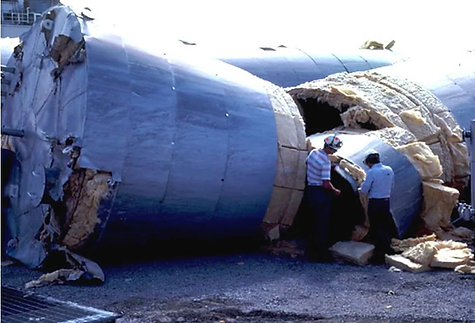
Example: Storage Tanks
Figure 1: This image shows the collapse of two 316L Stainless steel storage tanks containing 65% phosphoric acid.These tanks had survived for many years without losing integrity. Due to a loss of cooling capacity in the phosphoric acid plant, the acid was pumped to the storage tanks at 70C, instead of the usual 50C.At the elevated temperature, chlorides present in the phosphoric acid caused stress corrosion cracking in the heat affected zone of the welds where high residual stresses were present.

Figure 2: Widespread stress corrosion cracking in the heat affected zone of the weld caused the parent plate to separate from the circumferential weld, which remained intact.
Figure 3: A metallographic polished section was prepared from the cracked stainless steel. Electrolytic etching of the polished section in 10% oxalic acid srevealed branching transgraular cracks through the annealed austenite grains, typical of chloride stress corrosion cracking.

Marine Corrosion
The marine environment presents a unique set of challenges for engineered structures and components. The relentless combination of seawater, waves, marine organisms, and varying operational conditions can lead to various failure modes. Failure analysis in marine contexts aims to dissect these failures, enabling engineers and scientists to design more resilient marine systems and prevent future incidents.
Example: Weld Deterioration

Figure 1

Figure 2

Figure 3
Sea air can be bracing and refreshing, but the combination of moist air and chloride can lead to severe atmospheric corrosion.
This sequence of images demonstrates the deterioration of a weld on a coastal footbridge handrail over the course of three years.
Most of the hand rail facing the sea remained in good condition, protected by a galvanized coating of zinc.
Unfortunately, the protective zinc coating lost to heat during the welding process was not replaced.
This exposed the steel weldment to the sea air, leading to the complete destruction of the weld by marine corrosion during the three year observation period.

Figure 4
3D Printing & Additive Manufacturing
Additive Manufacturing provides the ability to improve efficiency, agility, and building complex structures not possible with traditional casting. The process of joining materials usually in layers allows manufacturing a wide variety of structures on demand, as needed and nothing more.
It also brings in new challenges with materials selection, component testing, and failure analysis. MTA Labs provides a variety of services to help you on your additive manufacturing journey.
Green Energy & Batteries
Material characterization: Techniques like Scanning Electron Microscopy (SEM), X-ray Diffraction (XRD), and chemical analysis can be used to investigate the microstructure, composition, and potential degradation of electrode materials, separators, and electrolytes.
Electrochemical testing: Specialized tests are conducted to evaluate the performance of individual battery components to study electrochemical reactions or impedance spectroscopy to measure internal resistance.